
This article contains affiliate links. If you buy through them, we may earn a commission at no extra cost to you. As an Amazon Associate, Your Prio earns from qualifying purchases. Educational content only, not medical advice.
Short answer: after 50, the best collagen supplement is a hydrolyzed powder that tells you exactly how many grams you get per serving, close to what studies used (about 2.5 to 10 grams a day), with no proprietary blend. We compared five popular powders on those points. Our overall pick for women who want several collagen types in one scoop is Advanced Collagen Plus; if you want a simple, single-ingredient powder, Vital Proteins Collagen Peptides or Sports Research Collagen Peptides are easy choices.
OUR TOP PICK
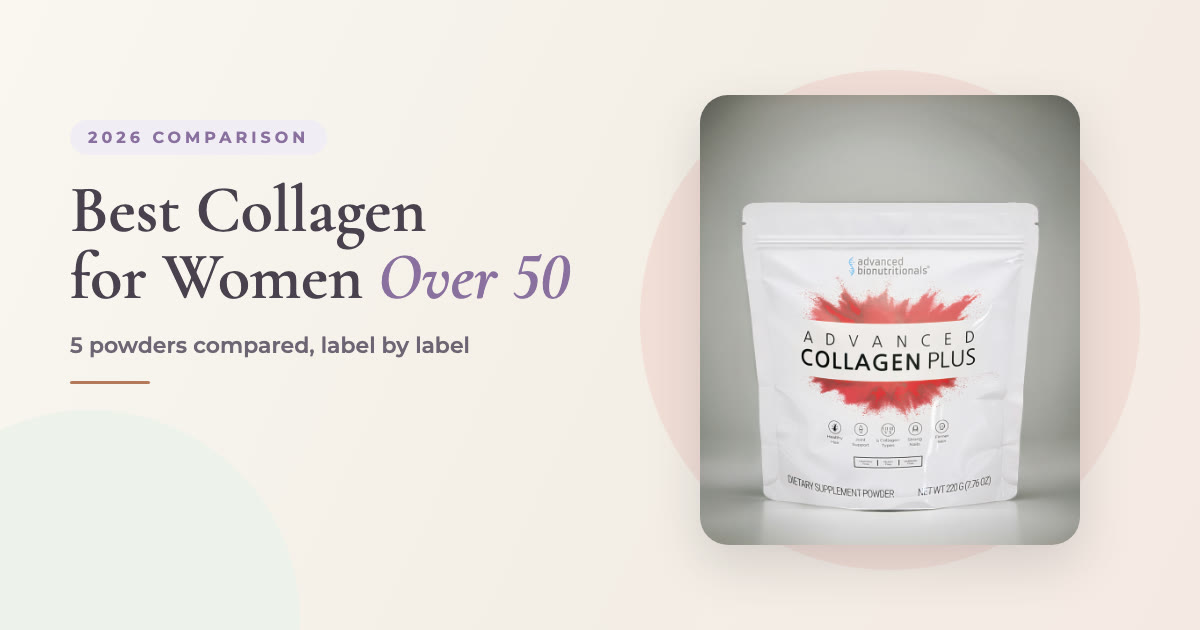
Advanced Collagen Plus
5 collagen types from 4 sources (beef, chicken, fish and eggshell membrane) plus biotin, unflavored, with a 90-day money-back guarantee.
The 5 collagen supplements we compared
| Product | Best for | Collagen per serving | Types & source | Worth knowing |
|---|---|---|---|---|
| Advanced Collagen Plus | Several collagen types in one scoop | See the label (amounts listed per type) | I, II, III, V, X · beef, chicken, fish, eggshell | Adds biotin and chondroitin · 20 servings per bag · 90-day guarantee |
| Vital Proteins Collagen Peptides | Classic, well-known peptides | 20 g | I & III · grass-fed beef | 0 g sugar · NSF Certified for Sport |
| Sports Research Collagen Peptides | Simple and budget-friendly | 11 g | I & III · beef | Single ingredient · Informed Choice certified |
| Orgain Collagen Peptides | Grass-fed, single ingredient | 20 g (2 scoops) | I & III · grass-fed, pasture-raised beef | Odorless, unflavored |
| Ancient Nutrition Multi Collagen | A multi-collagen you can find in stores | About 10 g per scoop (20 g per 2 scoops) | I, II, III, V, X · beef, chicken, fish, eggshell | Not for fish or egg allergies |
Label details checked in October 2026. Formulas and prices change, so always confirm on the current label.
How we chose
We don’t rank collagen by marketing claims. We read the Supplement Facts and checked five things: the form (hydrolyzed collagen or “collagen peptides”, the form used in most studies), a clear dose per serving, the collagen types and where they come from, whether amounts are hidden in a proprietary blend, and independent testing or certification. We also looked at how easy each powder is to use every day, because collagen only helps if you take it consistently for about 8 to 12 weeks.
1. Advanced Collagen Plus: best multi-collagen
Advanced Collagen Plus combines five collagen types (I, II, III, V and X) from four sources: grass-fed beef, pasture-raised chicken, wild-caught fish and eggshell membrane, plus biotin and chondroitin. It is unflavored and mixes into coffee, tea or water.
- Why we like it: several collagen types in one scoop, with the amounts shown on the label instead of a hidden blend.
- Trade-offs: higher price per serving than basic single-source powders, and 20 servings per bag.
- Not for: vegetarians, vegans, or anyone allergic to fish or eggs.
See Advanced Collagen Plus → Full review
2. Vital Proteins Collagen Peptides: classic all-rounder
One of the best-known collagen powders: 20 g of bovine collagen peptides (types I and III) per serving, from grass-fed, pasture-raised cattle, with 0 g sugar. It is NSF Certified for Sport, which means it was independently tested for banned substances and label accuracy.
- Why we like it: a full 20 g dose, unflavored, easy to find.
- Trade-offs: types I and III only; the serving is 4 tablespoons, so it is a lot of powder.
3. Sports Research Collagen Peptides: simple and budget-friendly
A single-ingredient powder with 11 g of hydrolyzed type I and III collagen per scoop. It is third-party tested and Informed Choice certified.
- Why we like it: one ingredient, one scoop, independently tested, usually a lower price per serving.
- Trade-offs: 11 g is plenty for most people, but less than the 20 g powders if that matters to you.
4. Orgain Collagen Peptides: grass-fed and odorless
20 g of grass-fed, pasture-raised type I and III collagen peptides per two-scoop serving. The only ingredient is bovine collagen peptides, and it is odorless and unflavored.
- Why we like it: clean label and a full dose.
- Trade-offs: two scoops per serving; types I and III only.
5. Ancient Nutrition Multi Collagen Protein: store-shelf multi-collagen
Another multi-collagen with types I, II, III, V and X from beef, chicken, fish and eggshell membrane. One scoop is about 10 g (the company lists 20 g of collagen per two scoops).
- Why we like it: easy to find in stores and online if you want several types.
- Trade-offs: you need two scoops to reach the higher dose; not for fish or egg allergies.
What the research says about collagen after 50
Your body makes less collagen every year, and the drop speeds up after menopause. When you take hydrolyzed collagen, your gut breaks it into small peptides, and some of those peptides appear to signal skin cells to make more of their own collagen.
- Skin: a 2021 review of 19 studies with more than 1,100 people found that hydrolyzed collagen improved skin hydration and elasticity, usually after 8 to 12 weeks, at doses of about 2.5 to 10 g a day.
- Bones: in one study of women after menopause, 5 g a day of specific collagen peptides was linked to better bone mineral density over a year. Promising, but more research is needed.
- Caution: many collagen studies are funded by manufacturers, and results are modest. Think “smoother and more hydrated”, not “ten years younger”.
The 7-point label checklist
- Hydrolyzed or “collagen peptides”. This is the form most studies used.
- A clear dose in grams. Look for roughly 2.5 to 10 g or more per serving.
- Types and sources listed. Types I and III are the main skin types; multi-collagens add II, V and X.
- No proprietary blend. If amounts are hidden, you can’t compare.
- Allergens. Check for fish and eggshell membrane if you have allergies.
- Sugar and sweeteners. Some flavored powders add more than you’d expect.
- Testing. NSF, Informed Choice or other third-party testing is a plus.
Tips to get more out of collagen
- Take it daily for at least 8 to 12 weeks before judging.
- Eat vitamin C (fruits and vegetables): your body needs it to build collagen.
- Wear sunscreen every day. Sun damage breaks collagen down faster than any powder builds it.
- Collagen is not a complete protein, so it does not replace protein-rich meals.
Frequently asked questions
How much collagen should a woman over 50 take a day?
Most skin studies used about 2.5 to 10 g of hydrolyzed collagen a day. Many powders give 10 to 20 g per serving, which is fine for most healthy adults. If you have kidney disease or other medical conditions, ask your doctor first.
Is multi-collagen better than collagen peptides?
Not necessarily. Most skin research used type I and III peptides. A multi-collagen adds other types (such as type II for cartilage), which some people prefer for convenience. The more important things are the dose and taking it consistently.
When will I see results?
Most studies measured changes after 8 to 12 weeks. Results are usually modest and gradual.
Can I put collagen in hot coffee?
Yes. Collagen peptides dissolve in hot or cold drinks, and normal coffee temperatures are not a problem for them.
Related: Best retinol creams for women over 40 · Advanced Collagen Plus review
Sources: de Miranda RB et al., International Journal of Dermatology, 2021 (review of 19 studies); König D et al., Nutrients, 2018 (bone density in postmenopausal women); Proksch E et al., Skin Pharmacology and Physiology, 2014. Product details from manufacturer labels and retailer listings, October 2026. This article is for general information and is not medical advice.
Leave a Reply